October 2026
Bovine Theileria and Anaplasmosis: Diagnostic Test Result Summary
By Gregg A. Hanzlicek, DVM, PhD, PAS
As we continue to identify more Theileria herds across the U.S., we can now offer a diagnostic summary of the results.
This article provides summary of our findings for both Anaplasma marginale and Theileria orientalis ikeda (TOI).
Theileria and anemia
One hundred sixty TOI PCR positive samples were evaluated for the indications of anemia. All blood samples were collected from animals suspected of TOI acute infection. Of the 160 samples, 2.9% had evidence of anemia (hematocrit less than 22).
This anemia prevalence in clinical animals is lower than we expected because like Anaplasmosis, clinical signs are believed to be primarily related to the level of anemia. It is plausible that some animals were past the acute stage and in the process of disease recovery. It is also possible that some of the samples originated from dehydrated animals and some samples were delayed arriving at KVDL; therefore, the hematocrits were artificially elevated. It is not likely in the author’s opinion after follow up communications with many submitters that a large percentage of hematocrits were affected by external events.
PCR Cycle Time Differences
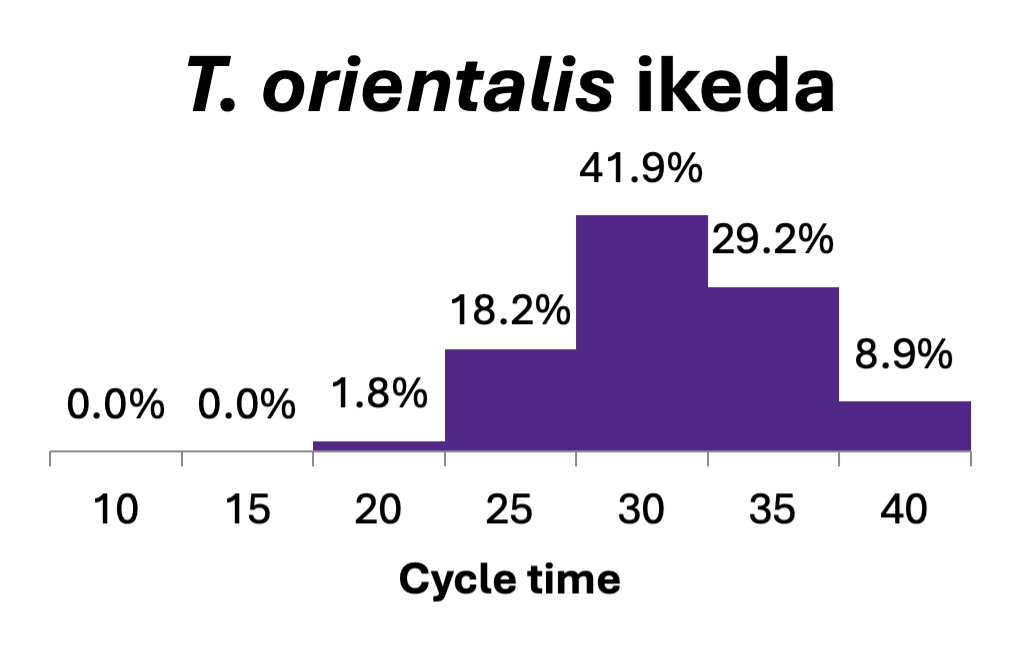
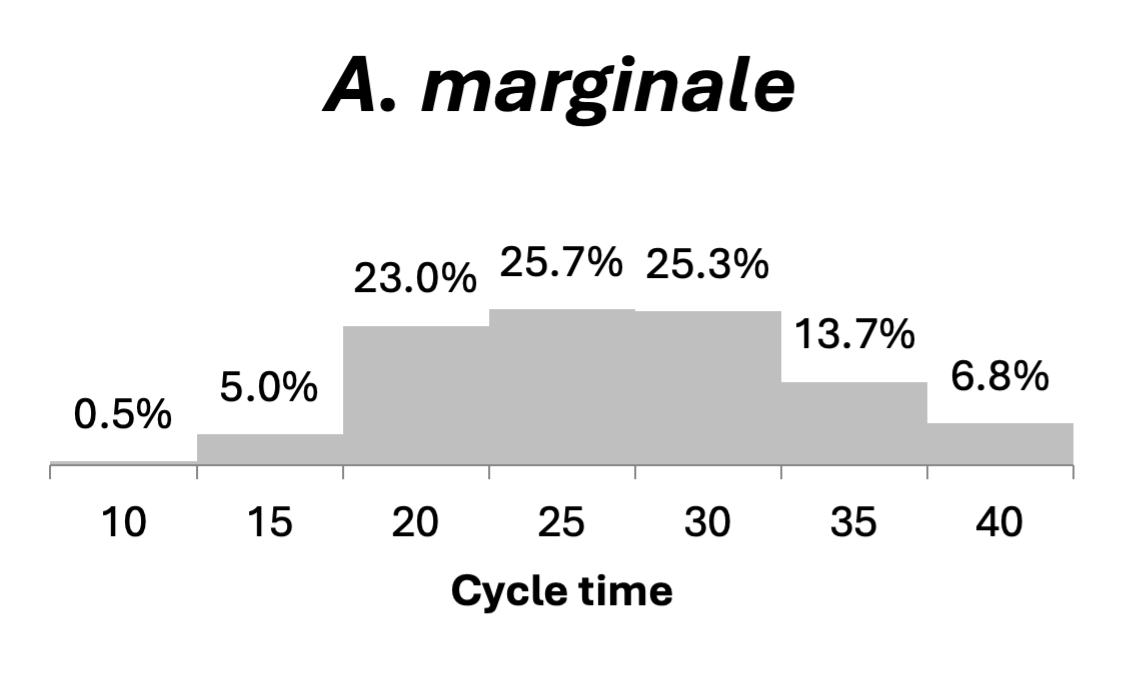
PCR cycle times (Ct.) are an estimate of the number of organisms in any test sample. (lower Ct. values equate to higher organism numbers). The histograms below illustrate that the parasite concentration level for TOI in most cases is much lower (higher Ct. values) than those observed in A. marginale samples. Twenty percent of TOI samples are at or below 30 Ct. (high level of infection) in comparison to 54.2% of A. marginale Ct. values.
The level of icterus is in part associated with the level of parasitemia. 2 Icterus as a clinical sign in TOI animals is reported much less than A. marginale infected animals. Could this be due to the level of parasitemia as measured by PCR? Additionally, some authors suggest acute A. marginale cases reach levels equating to Ct. levels of about 20 or below (with levels much above 20 assumed to be carriers).1 To the author’s knowledge no level of parasitemia has been established for acute TOI naturally infected bovines, and our best estimate of whether an animal is truly in acute or carrier states is limited. This limitation does cloud our ability to diagnose acute TOI cases in both antemortem and postmortem animals.
 |
 |
As blood parasites Anaplasmosis and Theileriosis share many commonalities in disease presentation and diagnostics there are distinct differences in diagnostic results and interpretations.
There is a lot yet to be learned about Theileria orientalis ikeda in North American bovine herds. KVDL, in partnership with several organizations, is actively studying multiple aspects of this disease in field studies across the Midwest.
Stay tuned for more information.
References:
- Veterinary Medicine. 10th Edition, 2006. Editor, Radostits
- Large Animal Medicine. 4th 2018. Editor, BP Smith